Radical Candor is one of those ideas that sounds simple until you try to use it in real life.
At its best, it gives you a way to be direct without becoming cold, and supportive without becoming vague. That balance matters in design, product, and engineering work because the goal is rarely just to be “nice” or “honest.” The goal is to help people do better work together.
Kim Scott’s framework is built on a straightforward idea: care personally and challenge directly. If you do both, feedback can be kind, clear, and useful. If you only do one, the message usually gets distorted.
The Core Idea
The model is easiest to understand as four quadrants:
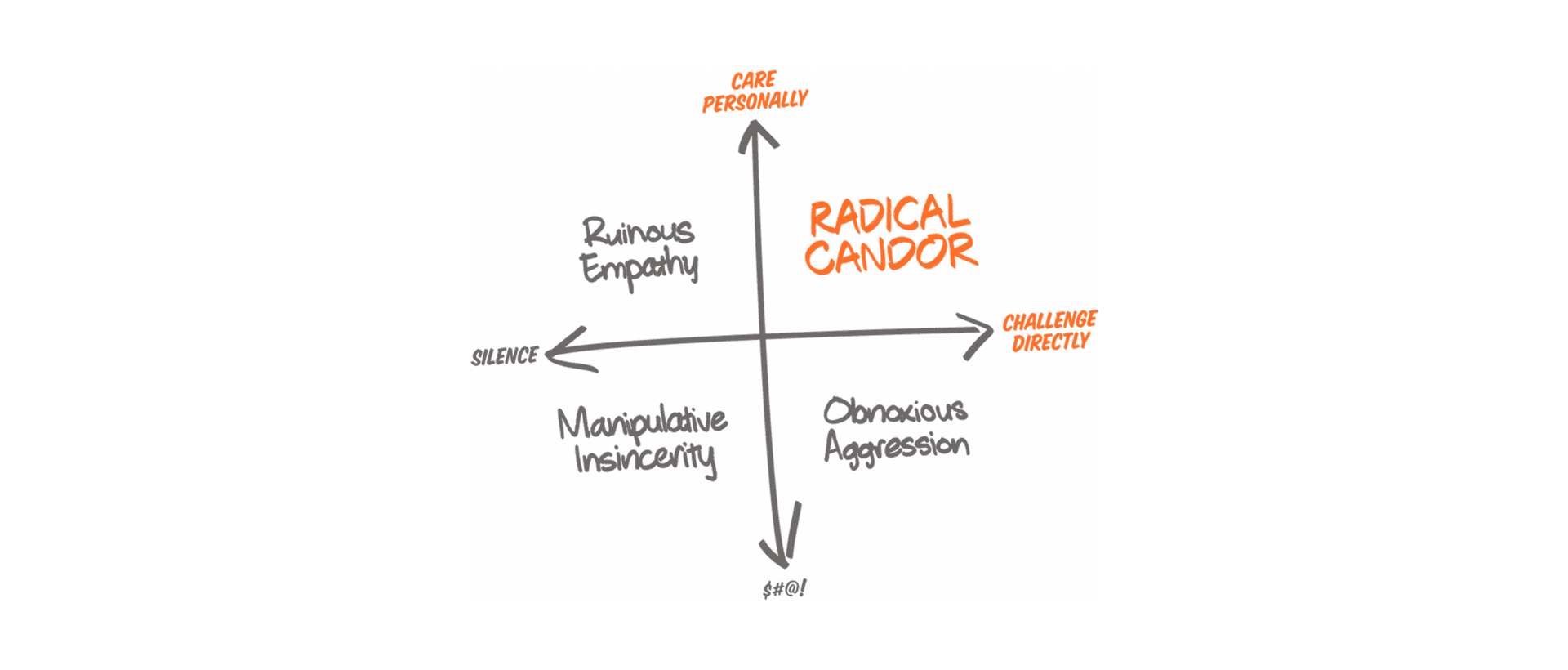
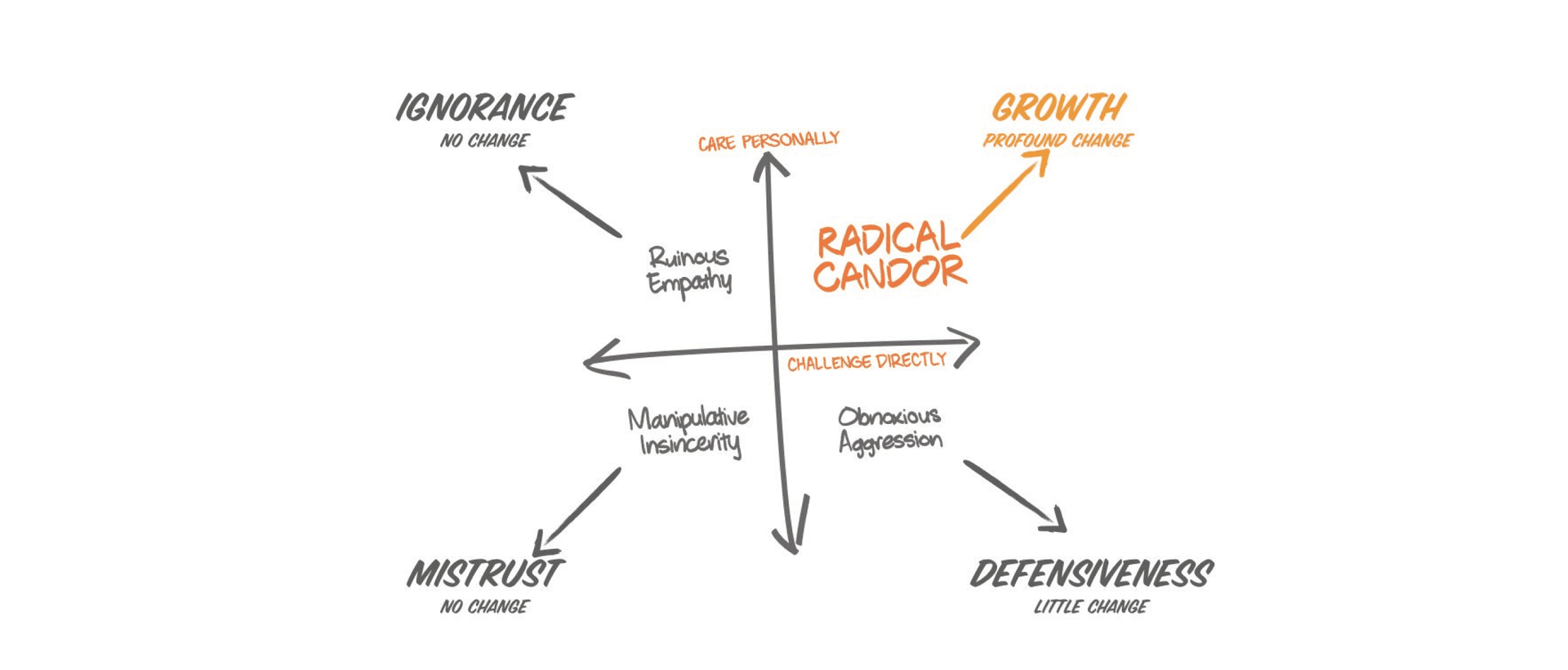
- Care personally and challenge directly: Radical Candor
- Care personally, but do not challenge directly: Ruinous Empathy
- Challenge directly, but do not care personally: Obnoxious Aggression
- Neither care nor challenge: Manipulative Insincerity
That map is useful because it describes what actually happens in teams. Most people do not think of themselves as avoidant or harsh. They think they are being thoughtful, efficient, or “protective.” Radical Candor is a reminder to check whether your intent and your delivery are aligned.
The story that gets cited most often comes from Scott’s time at Google. Sheryl Sandberg praised her work, then delivered a blunt piece of feedback about a verbal habit. The line landed because it came from someone who cared about her growth. The point was not to embarrass her. The point was to help her improve.
That is the standard worth aiming for.
What It Changes
Radical Candor changes the quality of the conversation.
Instead of making feedback about personality, it keeps the discussion close to behavior and impact. Instead of turning disagreement into a performance, it makes room for plain language. Instead of waiting until something becomes a problem, it encourages earlier, cleaner corrections.
That matters in design leadership especially, because the work is full of judgment calls. You are constantly balancing craft, speed, collaboration, and business constraints. If you cannot speak clearly about trade-offs, the team ends up absorbing friction instead of solving it.
Candor is not just about criticism either. Good praise is part of the model. When someone does something well, say exactly what it was and why it mattered. That turns recognition into a signal the team can learn from.
How To Practice It
Start with care
People hear direct feedback differently when they trust that you are on their side. That trust is built through consistency, follow-through, and ordinary human attention.
In practice, care is usually not dramatic. It is showing up in 1:1s, remembering what someone is trying to grow into, following through when you said you would, and treating people like adults who can handle the truth. It is also being willing to put their growth ahead of your own comfort.
That last part is easy to miss. Avoiding a hard conversation can feel kind in the moment, but it often leaves the other person carrying ambiguity they cannot act on. Care should make feedback easier to receive, not easier for the giver to avoid.
Be specific
The most helpful feedback points to one moment, one behavior, and one effect.
I try to keep this simple: what happened, what I saw or heard, what impact it had, and what I think should change next time.
That structure keeps the conversation grounded. It also keeps you from drifting into labels like “unprofessional,” “careless,” or “not strategic,” which usually create more heat than clarity.
Keep it timely and private
Hard feedback works better when it happens close to the moment and in a setting that gives the other person room to respond. Public correction tends to feel like a performance. Private correction tends to feel like help.
Praise can be public. Critique usually should not be.
Close the loop
Candor is incomplete if it stops at the comment.
If you raised an issue, make the next step clear. If you received feedback, confirm what you heard and what you will do differently. If the change happens, acknowledge it. If it does not, revisit it before it turns into a pattern.
Use the conversation flywheel
Difficult conversations can get messy because people often jump to the part they are most comfortable with. Some people skip straight to deciding. Some want to debate forever. Some move immediately into persuading because they already know where they want the room to land.
The Radical Candor “Get Stuff Done” wheel is useful because it slows that impulse down. Listen first. Clarify what is actually true. Debate the options. Decide who owns the call. Persuade people enough that they understand the decision, even if they did not get their preferred outcome. Execute clearly. Then learn from what happened.
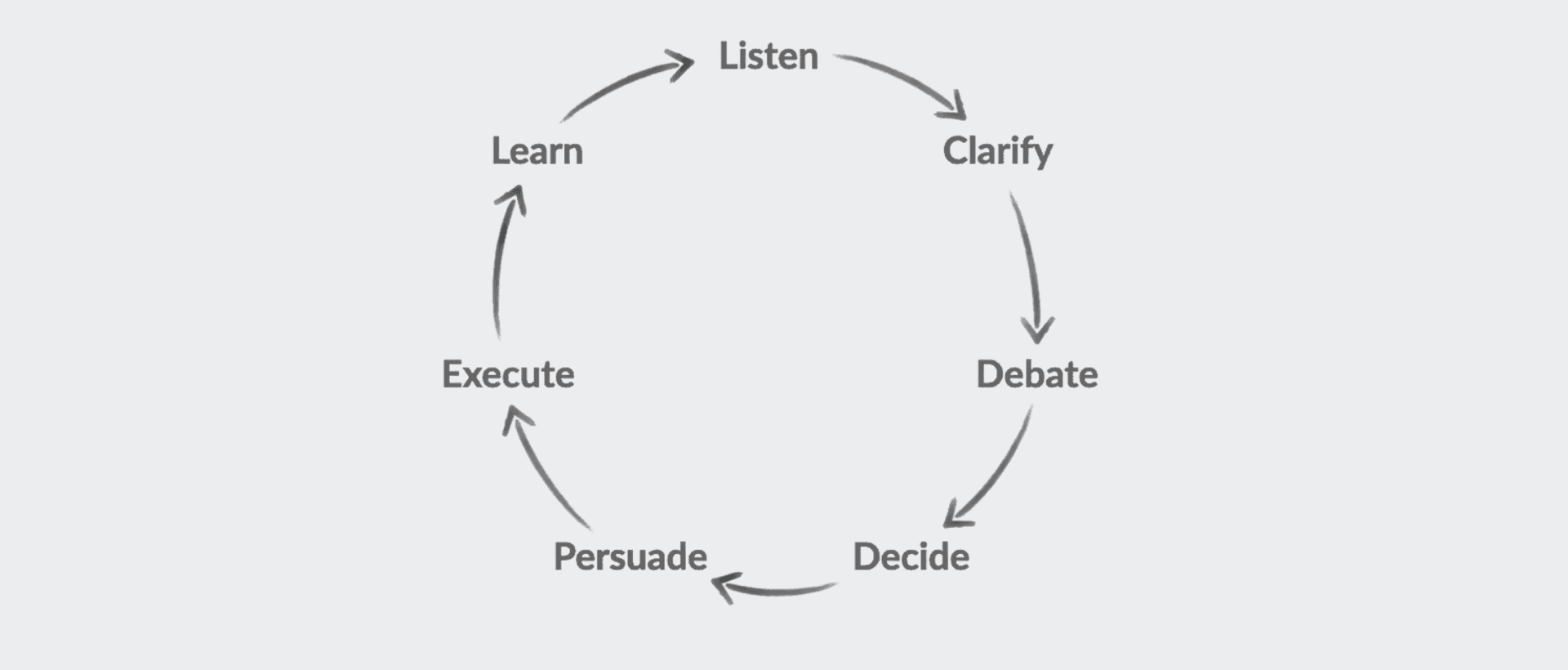
I like this model because it keeps candor from becoming a single dramatic moment. A hard conversation is rarely just one sentence of feedback. It is a loop of listening, sharpening, deciding, acting, and learning. When teams skip parts of that loop, the conversation usually comes back later in a messier form.
If you skip listening, people feel managed instead of involved. If you skip deciding, people stay stuck in discussion. If you skip learning, the same conversation keeps repeating with different names attached to it.
When To Use It
Radical Candor is useful anywhere a relationship has to survive honest feedback.
That can be a 1:1, a design review, a code review, a planning conversation, a retrospective, a performance discussion, or a postmortem. The setting changes, but the need is the same: people need enough truth to make a better decision, and enough care to stay open while hearing it.
I find it most useful when the team is drifting. Maybe the work is getting vague, the timeline is starting to slip, quality is uneven, or people are politely talking around the real issue. In those moments, soft language can feel safe but still create damage. Someone usually needs to name what is actually happening.
The point is not to make the room uncomfortable. The point is to make reality visible enough that the team can respond to it.
When Not To Force It
Radical Candor is not a reason to be reckless.
If you are angry, exhausted, or trying to win an argument, pause. If you do not have enough context, ask questions first. If the topic is sensitive, complicated, or high-stakes, choose the setting carefully and bring in the right support.
That matters for things like compensation, health, legal concerns, or HR issues. It also matters across cultures and power dynamics, where directness can land very differently depending on the room.
And just as importantly, candor is not the same as raw honesty. Saying everything that comes to mind is not leadership. Good leadership knows the difference between being truthful and being useful.
As a Manager
For managers, Radical Candor is less a technique than a standard.
You are shaping what “good” looks like. If your feedback is vague, your team will usually mirror that. If your expectations are clear, timely, and fair, people tend to rise to meet them.
This is where I have felt the value most. As a manager, I try to be as clear as possible about the state we are in and where I think the team needs to go. Not in a dramatic, commander-style way. More like: here is what I am seeing, here is what seems to be working, here is what is starting to cost us, and here is the direction I believe we need to move.
That kind of clarity gives people something to orient around. They know where they stand. They understand the trade-offs. They do not have to guess whether silence means approval, concern, or just a busy calendar.
For design leaders in particular, this can change the whole tone of the team. People stop guessing what you mean and start understanding what you value. Praise becomes more useful because it names the behavior you want repeated. Critique becomes less threatening because it shows up as part of the operating rhythm, not as a surprise verdict.
A manager’s candor should reduce guessing. If people leave every conversation trying to decode what you really meant, the feedback was not clear enough.
As an IC
You do not need a management title to practice candor.
As an IC, I think you have to be a little more careful with Radical Candor, not because your perspective matters less, but because power, timing, and trust work differently when you are not the person responsible for the team structure. Directness still matters. So does humility.
The best version is usually clear without being performative. You name your perspective, connect it to the work, and make it easy for the other person to stay in the conversation. “Here is what I am seeing” usually lands better than “here is what you did wrong.” “What do you think?” keeps the door open. “Here is what I need to do better work” is often more useful than quietly absorbing friction until resentment builds.
For example:
I want us to hit Thursday’s launch without surprises. In the kickoff, we changed scope without involving QA, and that created late defects. Could we add QA to the final review and freeze changes 24 hours before handoff? I can draft the checklist.
That works because it is specific, respectful, and aimed at the work rather than the person.
Working With Managers
Upward candor usually works best when it is framed around outcomes, not ego.
I would rather say, “I am worried this timeline is giving us speed but taking away quality,” than “this plan is bad.” The first version gives the manager something to work with. It names a trade-off. It invites a decision. The second version may be emotionally honest, but it does not help the conversation move.
The pattern I come back to is goal, observation, risk, option. Start with what everyone is trying to achieve. Share the concrete thing you are seeing. Explain what it may cost. Offer a path forward. If the decision matters, write it down afterward so it does not drift into different memories.
Working With Peers
Peer candor should feel like collaboration.
In peer relationships, the work is often the safest place to start. Speak to the artifact, the decision, the interaction, the plan, the handoff, the customer impact. Keep the person’s identity out of it.
If you can move from “you missed this” to “can we look at this together,” the whole conversation becomes easier to use.
That does not mean watering the feedback down. It means making the feedback easier to act on. A good peer critique should leave the other person with more clarity, not more defensiveness.
Common Misfires
This is the part I still have to work at.
The hardest part of Radical Candor is not always saying the thing. Sometimes it is saying the thing with enough context that the other person can actually understand where you are coming from. I can struggle with that. I may see a pattern, feel the urgency, or know the team is drifting, but getting the full picture out clearly is hard. There is always some mix of bias, emotion, incomplete information, and the pressure of the moment.
That is why I try to slow myself down just enough to separate what I know from what I am assuming. What did I actually see? What am I worried will happen? What part of this is my reaction, and what part belongs to the work? That pause matters because even well-intended feedback can land badly if it sounds like a verdict instead of a perspective.
Timing matters too. In general, sooner is better. Feedback that arrives close to the moment is lighter, clearer, and easier to use. When it comes weeks later, it can feel bigger than it needed to be, partly because the person has lost the context and partly because silence starts to feel misleading.
There are still moments where waiting is the right call. If I am angry, missing information, or too close to the problem, I need to ask more questions first. But waiting should be intentional, not avoidance wearing a nicer outfit.
Power makes all of this more complicated. A manager can think they are offering a casual observation, while the other person hears something much heavier. That means candor has to leave room for response. Ask what you are missing. Invite pushback. Make it clear that the other person is allowed to disagree, add context, or correct the story you are telling yourself.
Team Norms
The strongest teams do not leave candor to personality. They make it part of the operating model.
- Make feedback routine, not rare
- Separate praise from correction
- Keep hard feedback private
- Use one clear structure for giving feedback
- Agree on how fast feedback should be raised
- Normalize asking for clarification
That last point matters more than it sounds. A team that can ask, “What are you really trying to say?” is usually a team that can recover from misfires quickly.
Conclusion
Radical Candor is not really about being blunt. It is about being trustworthy enough to be direct.
That is what makes it valuable for leaders. It creates a way to tell the truth without turning the room defensive, and to offer support without making the message vague. Done well, it raises the quality of the work and the quality of the relationship at the same time.